Syntax
VAR16D = label |
set VAR16D to value of a label |
VAR16D = value16 |
set VAR16D to value16 |
VAR16D = VAR16S |
set VAR16D to VAR16S value |
VAR16D = VAR32S(L) |
set VAR16D to VAR32S(L) value |
VAR16D = VAR32S(H) |
set VAR16D to VAR32S(H) value |
VAR16D, dm = value16 |
set VAR16D from dm to value16 |
VAR16D, dm = VAR16S |
set VAR16D from dm to VAR16S |
VAR16D = (VAR16S), TypeMem |
set VAR16D to &(VAR16S) from TM |
VAR16D = (VAR16S+), TypeMem |
set VAR16D to &(VAR16S) from TM, then VAR16S += 1 |
(VAR16D), TypeMem = value16 |
set &( VAR16D) from TM to value16 |
(VAR16D), TypeMem = VAR16S |
set &( VAR16D) from TM to VAR16S |
(VAR16D+), TypeMem = value16 |
set &( VAR16D) from TM to value16, then VAR16D += 1 |
(VAR16D+), TypeMem = VAR16S |
set &( VAR16D) from TM to VAR16S, then VAR16D += 1 |
VAR32D(L) = value16 |
set VAR32D low word to value16 |
VAR32D(L) = VAR16S |
set VAR32D (L) to VAR16 value |
VAR32D(H) = value16 |
set VAR32D high word to value16 |
VAR32D(H) = VAR16S |
set VAR32D (H) to VAR16 value |
Legend: D (destination), S (source).
Operands label: 16-bit address of a TML instruction label
value16: 16-bit integer immediate value
VAR16x: integer variable VAR16x
VAR32x(L): the low word of VAR32x long variable
VAR32x(H): the high word of VAR32x long variable
Dm: data memory operand
TypeMem: memory operand.
(VAR16x): contents of variable VAR16x, representing a 16-bit address of a variable

Binary code

















| Description | Assigns a 16-bit value to a TML variable or a memory location. The options are: |
The destination is 16-bit TML variable and the source is: a 16-bit immediate value, a label, 16-bit TML variable, high or low part of a 32-bit TML variable or the contents of a memory location whose address is indicated by a 16-bit TML variable (a pointer).
The destination is a memory location whose address is indicated by a 16-bit TML variable (a pointer) and the source is: a 16-bit immediate value or a 16-bit TML variable.
The destination is the high or low part of a 32-bit TML variable and the source is: a 16-bit immediate value or a 16-bit TML variable.
If the pointer variable is followed by a + sign, after the assignment, it is incremented by 1. The memory location can be of 3 types: RAM for data (dm), RAM for TML programs (pm), EEPROM SPI-connected for TML programs (spi).

Some instructions use a 9-bit short address for the destination variable. Bit
value X specifies the destination address range:
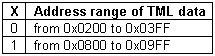
All predefined or user-defined TML data are inside these address ranges, hence these instructions can be used without checking the variables addresses. However, considering future developments, the TML also includes assignment instructions using a full address where the destination address can be any 16-bit value. In this case destination variable is followed by “,dm”.
Execution Copies a 16-bit value from the source to the destination
Example1
int Var1;
Label1: // Label1 = TML program address
...
Var1 = Label1;
Before instruction |
|
After instruction |
||
Label1 |
0x1234 |
|
Label1 |
0x1234 |
Var1 |
x |
|
Var1 |
0x1234 |
Example2
int Var1;
...
Var1 = 26438;
Before instruction |
|
After instruction |
||
Var1 |
x |
|
Var1 |
26438 |
Example3
int Var1, Var2;
...
Var2 = Var1;
Before instruction |
|
After instruction |
||
Var2 |
0x56AB |
|
Var2 |
0x56AB |
Var1 |
x |
|
Var1 |
0x56AB |
Example4
int Var1;
long Var3;
...
Var1 = Var3(L);
Before instruction |
|
After instruction |
||
Var3 |
0x56ABCD98 |
|
Var3 |
0x56ABCD98 |
Var1 |
x |
|
Var1 |
0xCD98 |
Example5
int Var1;
long Var3;
....
Var1 = Var3(H);
Before instruction |
|
After instruction |
||
Var3 |
0x56ABCD98 |
|
Var3 |
0x56ABCD98 |
Var1 |
x |
|
Var1 |
0x56AB |
Example6
int Var1;
...
Var1, dm = 3321;
Before instruction |
|
After instruction |
||
Var1 |
x |
|
Var1 |
3321 |
Example7
int Var1, Var2;
...
Var1, dm = Var2;
Before instruction |
|
After instruction |
||
Var1 |
0x0A01 |
|
Var1 |
0x0A01 |
Var2 |
x |
|
Var2 |
0x0A01 |
Example8
int Var1, pVar2;
...
Var1 = (pVar2), dm;
Before instruction |
|
After instruction |
||
pVar2 |
0x0A01 |
|
pVar2 |
0x0A01 |
Data memory |
|
|
Data memory |
|
0x0A01 |
0x1234 |
|
0x0A01 |
0x1234 |
Var1 |
x |
|
Var1 |
0x1234 |
Example9
int Var1, pVar2;
...
Var1 = (pVar2+), dm;
Before instruction |
|
After instruction |
||
pVar2 |
0x0A01 |
|
pVar2 |
0x0A02 |
Data memory |
|
|
Data memory |
|
0x0A01 |
0x1234 |
|
0x0A02 |
0x0014 |
Var1 |
x |
|
Var1 |
0x0014 |
Example10
int pVar1;
...
(pVar1), spi = 0x5422;
Before instruction |
|
After instruction |
||
pVar1 |
0x5100 |
|
pVar1 |
0x5100 |
SPI data memory |
|
|
SPI data memory |
|
0x1100 |
x |
|
0x1100 |
0x5422 |
|
|
|
(SPI memory offset is 0x4000, i.e. SPI addr = var.addr – 0x4000) |
|
Example11
int pVar1;
...
(pVar1+), spi = 0x5422;
Before instruction |
|
After instruction |
||
pVar1 |
0x5100 |
|
pVar1 |
0x5101 |
SPI data memory |
|
|
SPI data memory |
|
0x1100 |
x |
|
0x1100 |
0x5422 |
|
|
|
(SPI memory offset is 0x4000, i.e. SPI addr = var.addr – 0x4000) |
|
Example12
int pVar1, Var2;
...
(pVar1), pm = Var2;
Before instruction |
|
After instruction |
||
pVar1 |
0x8200 |
|
pVar1 |
0x8200 |
Var2 |
0xA987 |
|
Var2 |
0xA987 |
pm data memory |
|
|
pm data memory |
|
0x8200 |
x |
|
0x8200 |
0xA987 |
Example13
int pVar1, Var2;
...
(pVar1+), pm = Var2;
Before instruction |
|
After instruction |
||
pVar1 |
0x8200 |
|
pVar1 |
0x8201 |
Var2 |
0xA987 |
|
Var2 |
0xA987 |
pm data memory |
|
|
pm data memory |
|
0x8200 |
x |
|
0x8200 |
0xA987 |
Example14
long Var5;
...
Var5(H) = 0xAA55 ;
Before instruction |
|
After instruction |
||
Var5 |
0x12344321 |
|
Var5 |
0xAA554321 |
Example15
long Var5;
...
Var5(L) = 0xAA55;
Before instruction |
|
After instruction |
||
Var5 |
0x12344321 |
|
Var5 |
0x1234AA55 |
Example16
int Var1;
long Var5;
...
Var5(H) = Var1;
Before instruction |
|
After instruction |
||
Var1 |
0x7711 |
|
Var1 |
0x7711 |
Var5 |
0x12344321 |
|
Var5 |
0x77114321 |
Example17
int Var1;
long Var5;
...
Var5(L) = Var1;
Before instruction |
|
After instruction |
||
Var1 |
0x7711 |
|
Var1 |
0x7711 |
Var5 |
0x12344321 |
|
Var5 |
0x12347711 |